
- Premier Spine Care
- Spondylolisthesis
Spondylolisthesis Treatment in Kansas City
Spondylolisthesis means one bone of the spine has slipped forward over the one below it. Many people have a small slip and few symptoms. When the slip pinches the nerves, treatment ranges from therapy to surgery that frees the nerves and steadies the spine.
Medically reviewed by Adrian P. Jackson, MD, board-certified, fellowship-trained spine surgeon · Updated November 2026
Appointments are scheduled through workers’ compensation referrals in Kansas and Missouri.
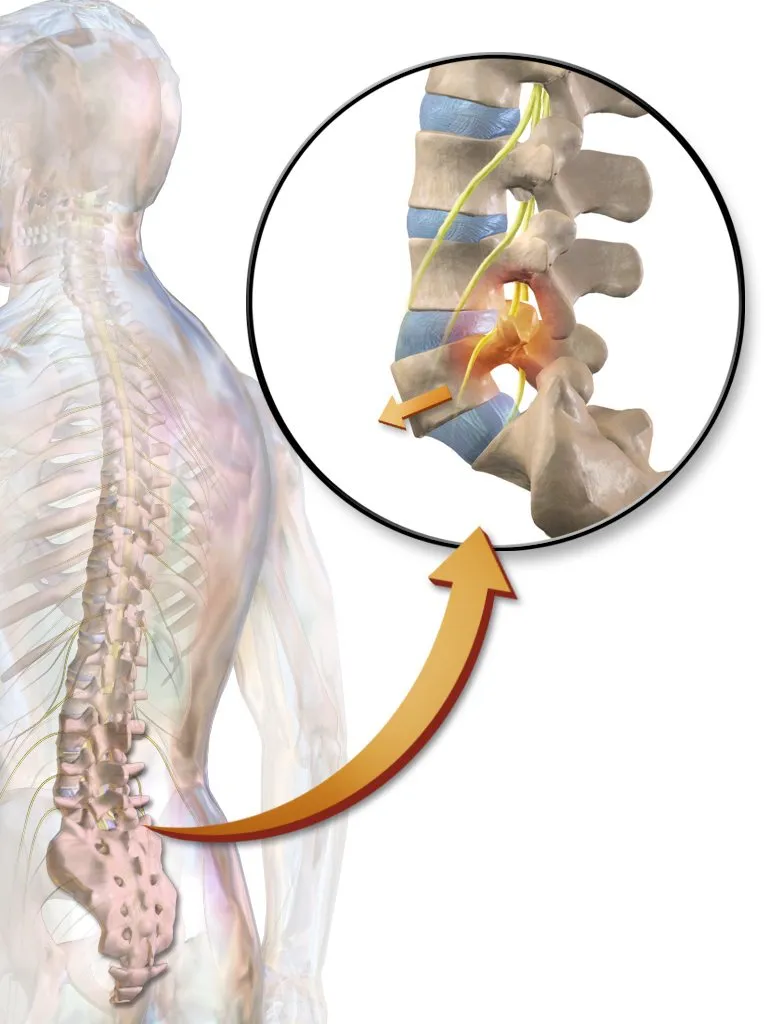
- A slipped vertebramost often at the lowest two levels
- Back and leg painworse with standing and walking
- Many need no surgerytherapy and injections come first
- Fusion steadies the spinewhen the slip is unstable or the nerves are pinched
The short answer
Spondylolisthesis is a forward slip of one vertebra on the one below. In adults it usually comes from arthritis of the spine joints (degenerative) or from a small stress fracture at the back of the vertebra (isthmic). The slip can narrow the canal and pinch the nerves to the legs.
Mild slips are treated with physical therapy, medication and injections. When leg pain or difficulty walking persists, surgery removes the pressure on the nerves. A fusion is often added to keep the slipped segment from moving.
Two common kinds in adults
Degenerative
Arthritis loosens the joints that hold the vertebrae in line, most often at L4-L5. Typical after age 50 and more common in women.
Isthmic
A small stress fracture in the back of the vertebra, often from adolescence, allows a slip, usually at L5-S1. It may cause no trouble until adulthood.
Graded by how far it has slipped
Grade 1 is a slip of less than a quarter of the vertebra. Most adult slips are grade 1 or 2.
Stable or unstable
X-rays taken bending forward and backward show whether the slip moves. That affects the choice of treatment.
What it feels like
Some slips are found by chance on an X-ray and never cause symptoms. When they do, the usual complaints are:
- Low back pain that is worse with standing, walking or arching backward.
- Leg pain, numbness or heaviness in one or both legs, from nerves pinched by the slip.
- Relief with sitting or bending forward, as in spinal stenosis.
- Tight hamstrings and a stiff low back.
If this began with an injury at work, our office handles workers' compensation claims in Kansas and Missouri every day. See how a work-injury claim moves from referral to full duty.
From therapy to surgery
The size of the slip matters less than your symptoms and whether the segment is stable.
- First
Physical therapy and activity changes
Core strengthening, hamstring stretching and avoiding repeated backward bending.
- First
Medication and injections
Anti-inflammatory medication and epidural steroid injections for leg symptoms.
- If needed
Decompression
Removing bone and ligament to free the pinched nerves. In a stable, low-grade slip this may be done alone. About laminectomy.
- If needed
Decompression with fusion
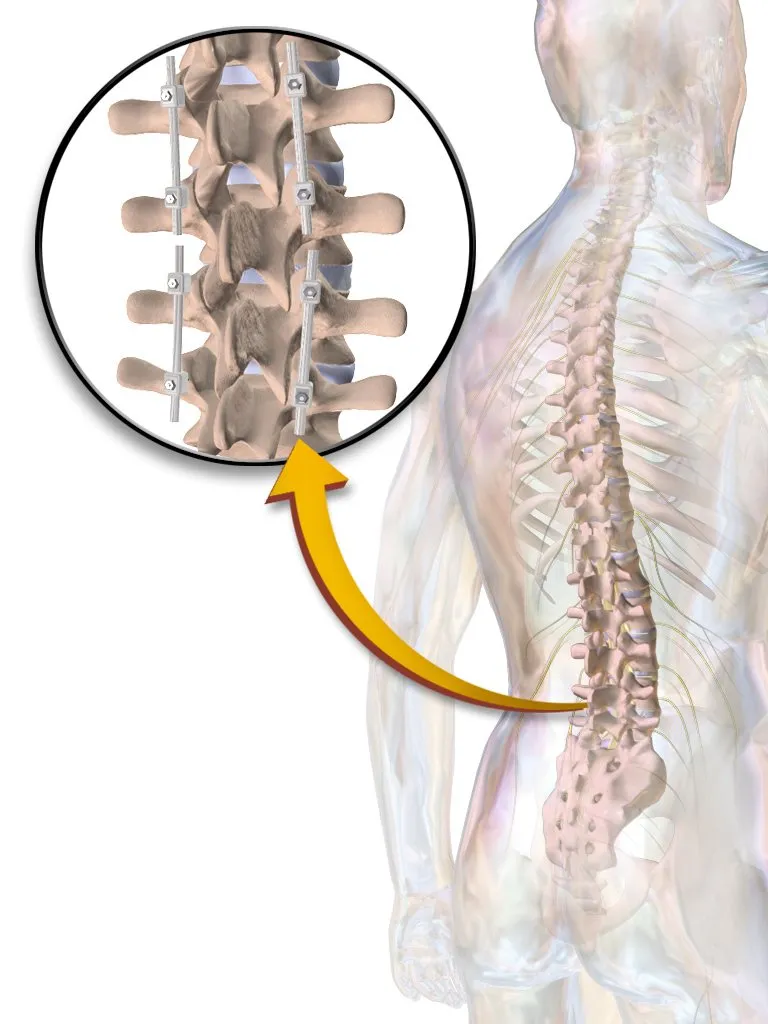
When the slip is unstable or the decompression would make it so, the segment is fused with bone graft, screws and rods. See the lumbar fusion recovery guide.
See the condition and the fusion
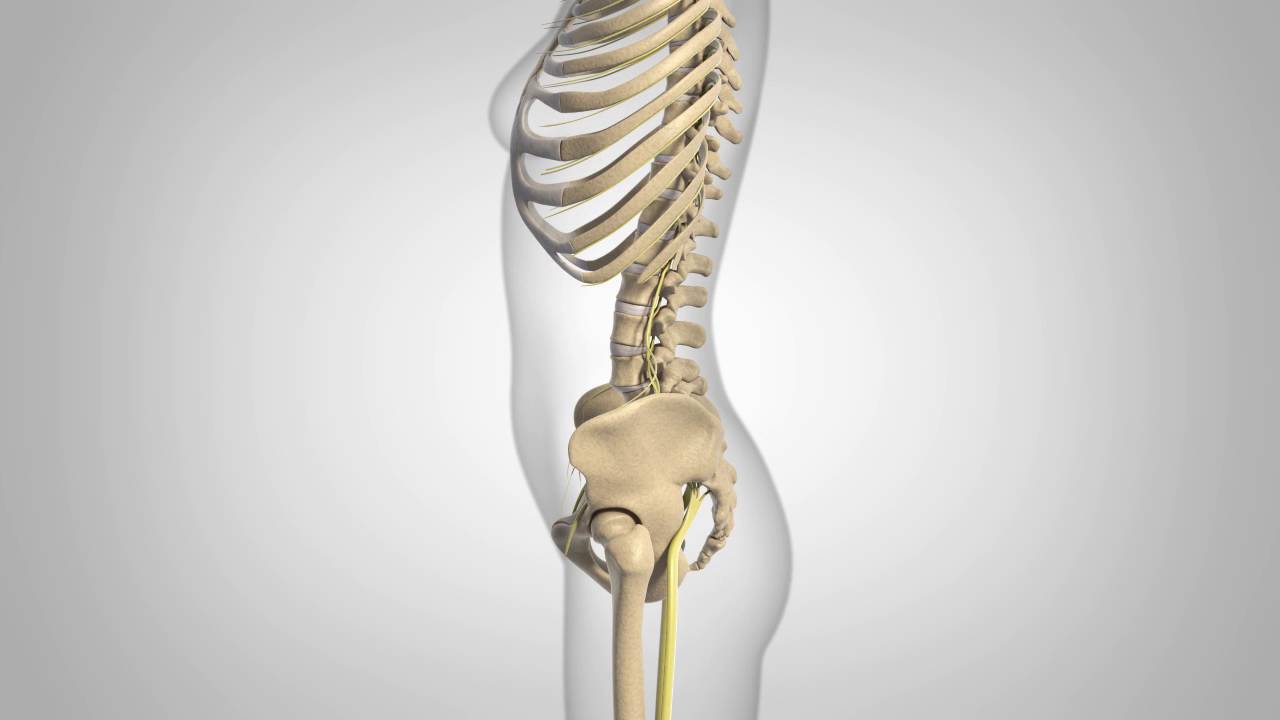
How a degenerative slip develops and pinches the nerves.
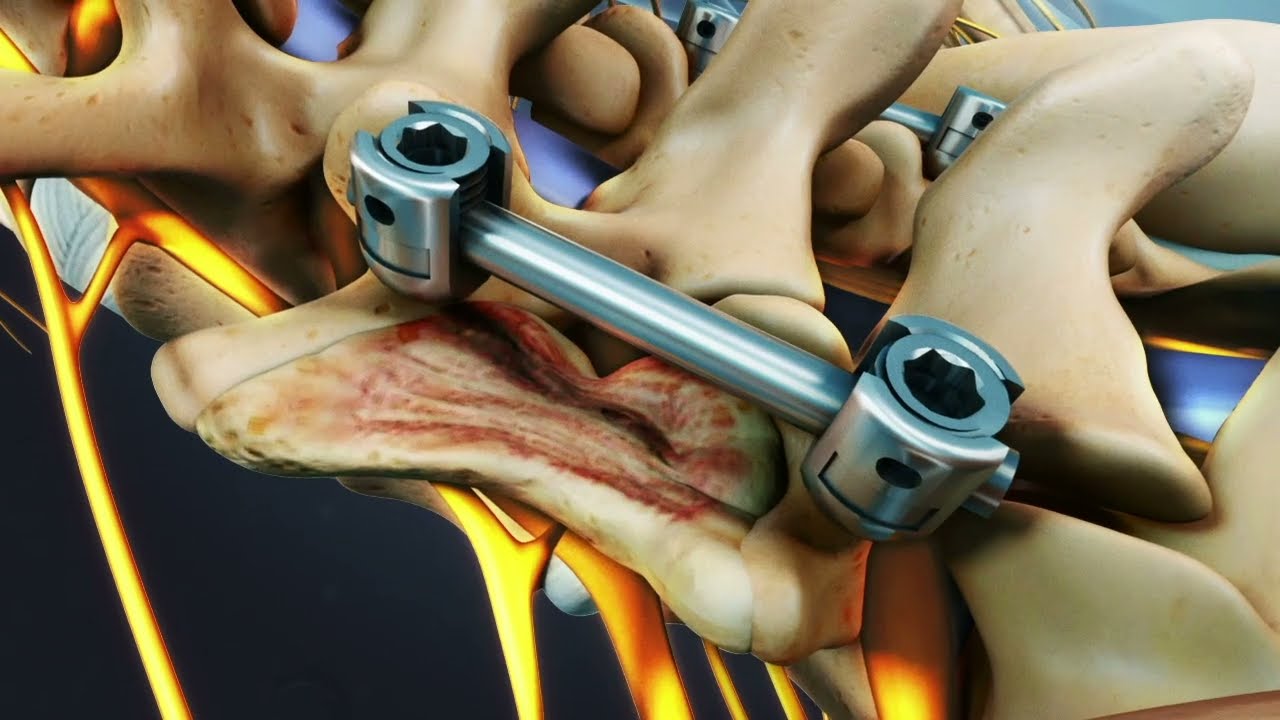
How a posterolateral fusion steadies the spine.

Your surgeon
John M. Ciccarelli, MD
Dr. Ciccarelli specializes in the lumbar spine, with a focus on an efficient return to function for patients who need surgery for spondylolisthesis.
- Board certified, American Board of Orthopaedic Surgery
- Spine fellowship, Scoliosis and Spine Center, Baltimore
- Orthopaedic residency, Orlando Regional Medical Center
- Lumbar fusion and reconstructive surgery
- Offices in Overland Park and Lenexa
Questions patients ask
Does spondylolisthesis always need a fusion?
No. Many people never need surgery. Among those who do, a stable low-grade slip can sometimes be treated with decompression alone. A fusion is added when the segment is unstable or would become unstable after the nerves are freed.
Can a slipped vertebra be put back in place?
Partial correction often happens during a fusion, but restoring perfect alignment is not the goal in most adults. The goals are to free the nerves and to stop the abnormal motion.
Is exercise safe with spondylolisthesis?
Yes, and it is encouraged. Walking, cycling, swimming and core strengthening are generally well tolerated. Activities that repeatedly arch the back are the ones to limit. A physical therapist can tailor a program.
How long is recovery after a lumbar fusion?
A lumbar fusion typically involves a hospital stay of 2 to 3 days. Strenuous work is avoided for 6 to 8 weeks, light work follows, and a solid fusion with release to normal duties is expected at about 6 months.
Will the slip get worse?
Degenerative slips progress slowly, if at all, and rarely beyond grade 2. Follow-up X-rays are used when symptoms change.
This page is general education. It does not replace an examination, and it is not medical advice for your situation. If you have severe or sudden symptoms, call 911 or go to the nearest emergency room.
Keep reading
Appointments for work injuries
Premier Spine Care schedules appointments through workers’ compensation referrals in Kansas and Missouri. Case managers, adjusters and law offices can send a referral online, and the appointment is scheduled within 24 hours. If you were hurt at work, ask your adjuster or case manager about a referral.
Premier Spine Care · Overland Park and Lenexa, Kansas · Serving the Kansas City metro in Kansas and Missouri