

1. Premier Spine Care
  2. Herniated Disc
Condition · Neck and low back

Herniated Disc Treatment in Kansas City

A herniated disc is one of the most common reasons for arm or leg pain that starts in the spine. Most people get better without surgery. When surgery is the right step, it is usually a short outpatient procedure.

Medically reviewed by Adrian P. Jackson, MD, board-certified, fellowship-trained spine surgeon · Updated November 2026

Appointments are scheduled through workers’ compensation referrals in Kansas and Missouri.

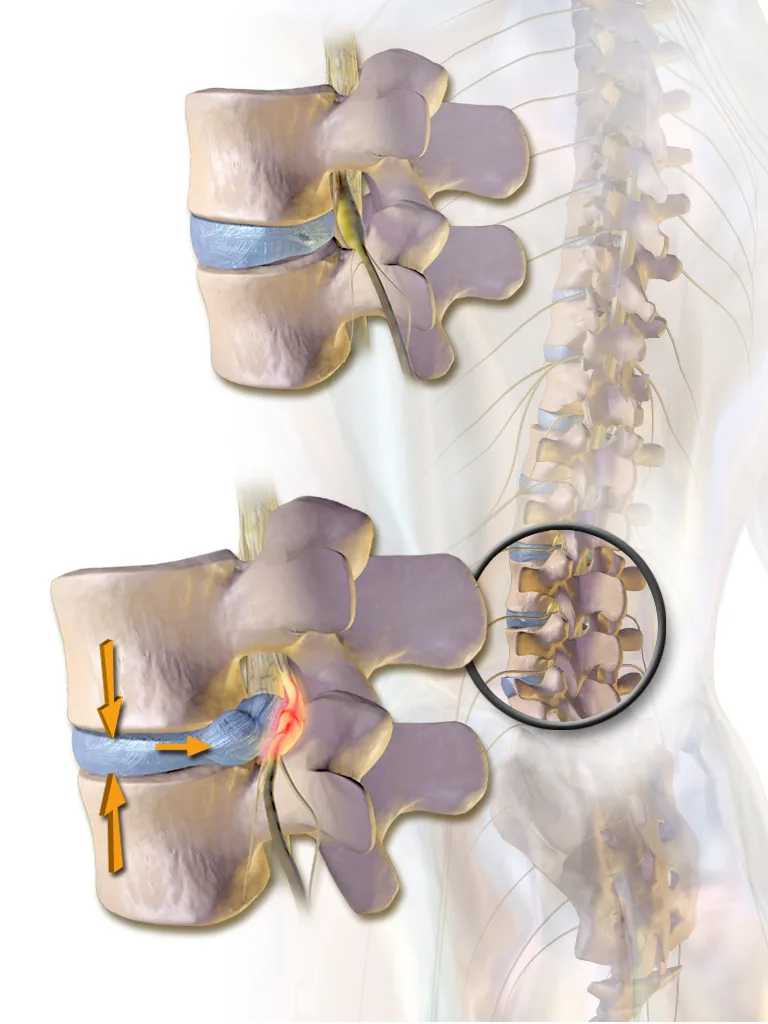
A healthy spinal disc above and a herniated disc below, where disc material presses on a spinal nerve
Top: a healthy disc. Bottom: disc material has pushed out and presses on the nerve beside it. Illustration: BruceBlaus, CC BY 3.0.

The short answer

A herniated disc happens when the soft center of a spinal disc pushes through its outer ring and presses on a nearby nerve. In the low back it causes leg pain (sciatica). In the neck it causes arm pain.

Most herniated discs calm down with time, physical therapy, medication and sometimes an injection. Surgery is considered when pain or weakness has not improved after a fair trial of that care, or sooner if the nerve or spinal cord is under significant pressure.

What is happening

A disc that presses on a nerve

Discs are the cushions between the bones of the spine. Each has a tough outer ring and a soft center. With age, strain or a sudden injury, the ring can weaken or tear and the center pushes out.

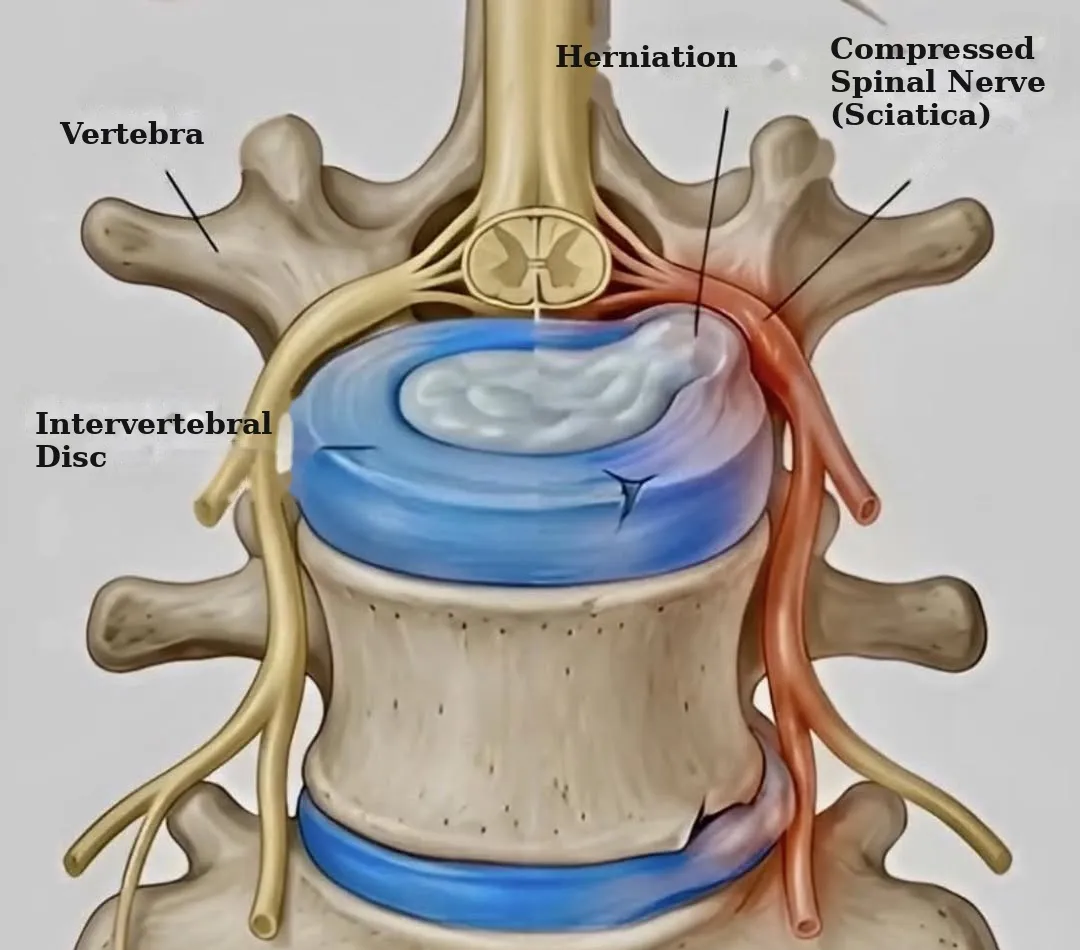
The disc itself is not the main problem. The trouble starts when the displaced material presses on a nerve root, or releases chemicals that inflame it. That is why the pain usually travels: down the leg from a low-back disc, or into the shoulder, arm and hand from a neck disc.

An MRI shows the level and the side. The findings have to match your symptoms and your examination, because many people have disc bulges on MRI that cause no trouble at all.

A herniated lumbar disc pressing on an exiting spinal nerve, shown in red
A herniated lumbar disc. The displaced material presses on the exiting nerve (red), which produces leg pain.
Symptoms

What a herniated disc feels like

Symptoms depend on which nerve is involved. They are usually on one side.

  • Shooting pain

    Sharp, electric or burning pain down the leg (low back) or down the arm (neck).

  • Numbness or tingling

    Pins and needles in a specific part of the leg, foot, arm or hand.

  • Weakness

    A foot that slaps or drags, a weak grip, or trouble lifting the arm.

  • Worse with certain positions

    Sitting, bending, coughing or sneezing often makes low-back disc pain worse.

When to see a spine surgeon

See a spine specialist if arm or leg pain has lasted more than a few weeks, keeps you from working or sleeping, or comes with weakness. An examination and the right imaging answer two questions: what is pressing on the nerve, and whether it is likely to settle on its own.

If this began with an injury at work, our office handles workers' compensation claims in Kansas and Missouri every day. See how a work-injury claim moves from referral to full duty.

Get care right away if you have

  • New trouble controlling your bladder or bowels
  • Numbness in the groin or inner thighs
  • Weakness in a leg or arm that is getting worse
  • Severe pain after a fall, crash or other injury
  • Fever with new back or neck pain

These can signal pressure on the nerves or spinal cord that should not wait. Call 911 or go to the nearest emergency room.

Treatment

Treatment starts with the least invasive step

Most patients never reach the last step. Each step is given a fair trial before moving to the next, unless the nerve is in danger.

  1. Most patients

    Time, activity and medication

    Staying active within comfort, short-term anti-inflammatory or nerve-pain medication, and avoiding the positions that set off the pain. Bed rest does not help.

  2. Most patients

    Physical therapy

    A guided program to calm the nerve, restore motion and strengthen the muscles that support the spine.

  3. Some patients

    Epidural steroid injection

    Anti-inflammatory medicine placed next to the irritated nerve under X-ray guidance. It can reduce pain enough for the disc to heal and for therapy to work.

  4. If needed

    Outpatient surgery

    When pain or weakness persists, surgery removes the pressure. In the low back this is a microdiscectomy. In the neck it is an ACDF or a cervical disc replacement. Most patients go home the same day.

Short video

See how a disc herniates

This short animation shows how a disc herniates, why it causes pain that travels, and how the body and conservative treatment calm it down.

If surgery becomes the right choice, the lumbar decompression recovery guide walks through each week from surgery day to full activity.

Your surgeons

Two fellowship-trained spine surgeons

Adrian P. Jackson, MD

Adrian P. Jackson, MD

Board-certified, fellowship-trained spine surgeon

Dr. Jackson has practiced spine surgery in the Kansas City area for more than 20 years. He treats both the neck and the low back, and he operates exclusively on an outpatient basis using minimally invasive techniques.

  • Board certified, American Board of Orthopaedic Surgery
  • Spine fellowship, Twin Cities Spine Center
  • Orthopaedic residency, Northwestern University

About Dr. Jackson
John M. Ciccarelli, MD

John M. Ciccarelli, MD

Board-certified, fellowship-trained spine surgeon

Dr. Ciccarelli specializes in the lumbar spine, including fusion for spondylolisthesis and other conditions where the spine needs to be stabilized.

  • Board certified, American Board of Orthopaedic Surgery
  • Spine fellowship, Scoliosis and Spine Center, Baltimore
  • Orthopaedic residency, Orlando Regional Medical Center
About Dr. Ciccarelli
Common questions

Questions patients ask

Can a herniated disc heal on its own?

Often, yes. The body gradually absorbs much of the displaced disc material, and the nerve inflammation settles. Most people improve within 6 to 12 weeks with conservative care.

How do I know if I need surgery?

Surgery is considered when leg or arm pain has not improved after a fair trial of conservative care, when weakness is significant or getting worse, or when the spinal cord or the nerves that control the bladder and bowels are compressed. The decision is based on your symptoms, your examination and your MRI together.

How long is recovery after disc surgery?

After a lumbar microdiscectomy or a single-level neck procedure, most of our patients go home the same day. Our routine protocol returns patients to full-time work with restrictions at about 6 weeks and to full activity at about 12 weeks. Desk work is often possible sooner.

Is a bulging disc the same as a herniated disc?

No. A bulge is a disc that extends slightly beyond its normal border and is very common on MRI, often with no symptoms. A herniation means the inner material has pushed through the outer ring. Either one matters only if it matches your symptoms.

Will the disc herniate again?

It can. A small percentage of patients have a repeat herniation at the same level, most often in the first months after surgery. Following your activity guidelines during recovery lowers that risk.

This page is general education. It does not replace an examination, and it is not medical advice for your situation. If you have severe or sudden symptoms, call 911 or go to the nearest emergency room.

Appointments for work injuries

Premier Spine Care schedules appointments through workers’ compensation referrals in Kansas and Missouri. Case managers, adjusters and law offices can send a referral online, and the appointment is scheduled within 24 hours. If you were hurt at work, ask your adjuster or case manager about a referral.

Premier Spine Care · Overland Park and Lenexa, Kansas · Serving the Kansas City metro in Kansas and Missouri
Call Refer a patient