
Lumbar Spinal Fusion
A posterior lumbar fusion joins two or more vertebrae into one solid bone to stop painful motion and protect the nerves. Our Kansas City-area patients typically spend 2 to 3 days in the hospital, and fusion takes about six months to become solid. That's when most patients are released to normal duties.
Medically reviewed by John M. Ciccarelli, MD, board-certified, fellowship-trained spine surgeon · Updated October 2026
When too much motion is the problem
A fusion is recommended when a segment of the low back moves more than it should, or when the disc and joints are too damaged to recover. Common reasons include spinal instability, certain cases of severe degenerative disc disease, fractures, and disc herniations that keep coming back.
One frequent cause of instability is spondylolisthesis: a vertebra slips forward over the one below it, often after a stress fracture in the bony ring at the back of the spine. Excess motion inflames the disc and joints, causing low back pain that can spread into the buttocks and thighs. It can also narrow the openings where the nerves exit, pinching them and sending pain down one or both legs.
Fusing the segment stops that motion, protects the nerves, and helps slow further wear at that level. As with every procedure we perform, fusion is considered only after all conservative care has failed to provide enough relief.
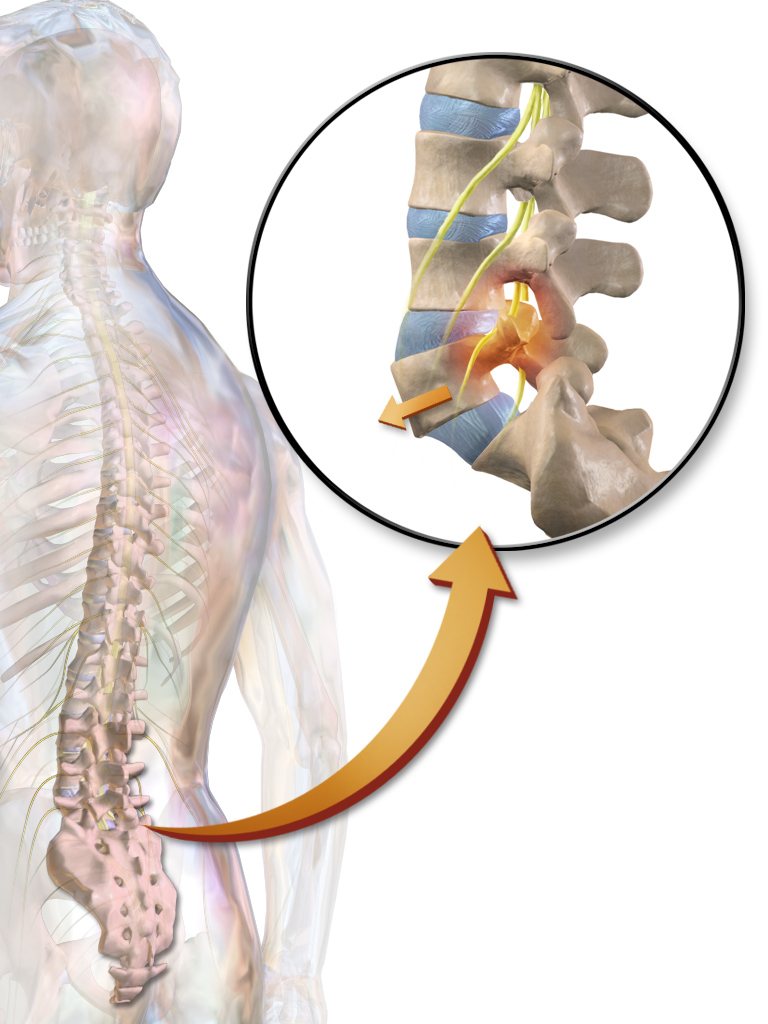
Free the nerves, then hold the spine still while it heals
Decompression. Through an incision down the middle of the low back, the surgeon first takes pressure off the nerves, removing part of the lamina (the bony roof of the spinal canal), disc fragments, and bone spurs as needed.
Fusion. Bone graft is laid along the back and sides of the spine (a posterolateral fusion). Over the following months the body heals the vertebrae together, the same way it heals a broken bone.
Screws and rods. Metal instrumentation holds the vertebrae still while they fuse. Less motion means a better chance of a solid fusion. In some cases a spacer filled with bone graft is also placed where the disc was removed (a posterior lumbar interbody fusion, or PLIF) for extra support.
- 2–4 hoursTypical time in surgery, depending on the number of levels
- 2–3 daysTypical hospital stay
- Walking day oneWith help from a physical therapist or nurse
- About 6 monthsFor the fusion to become solid
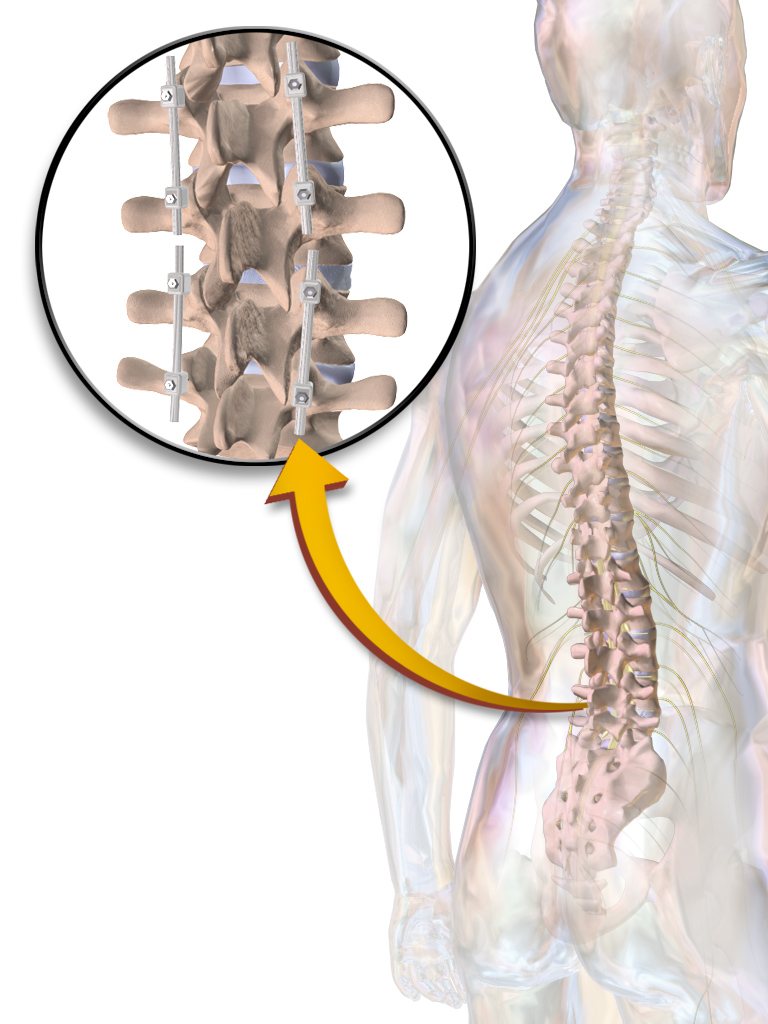
See how it works
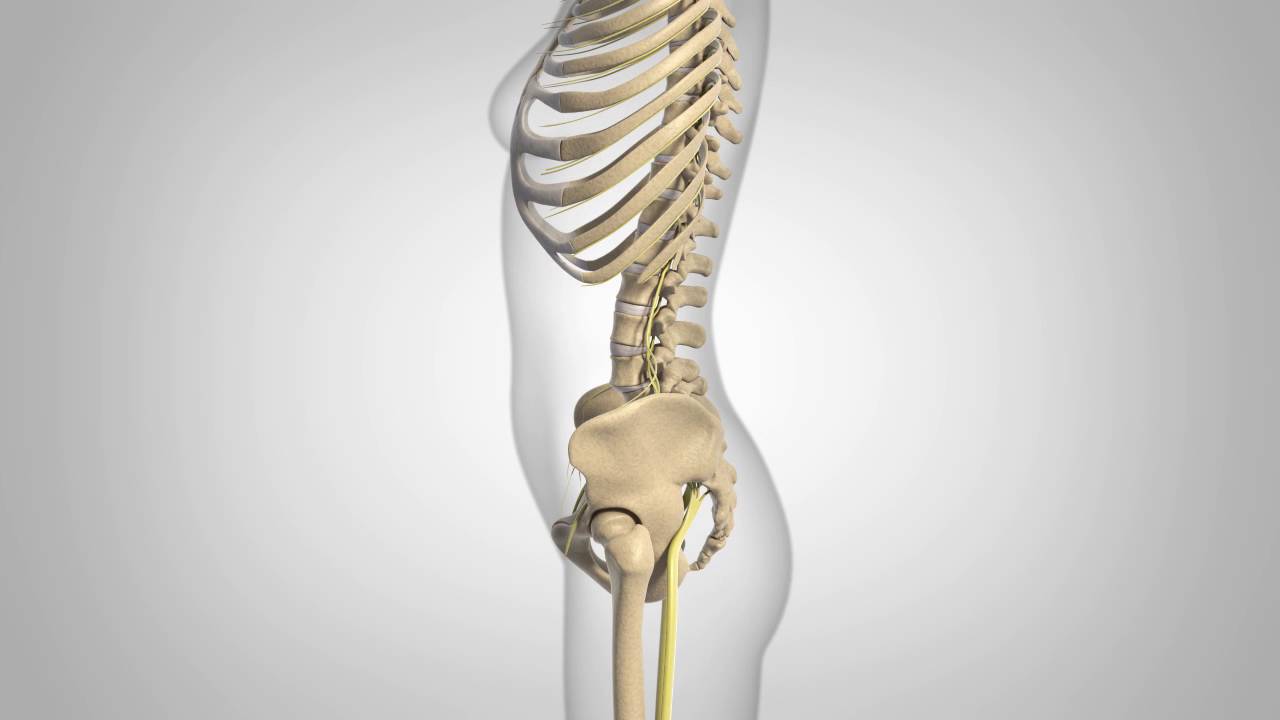
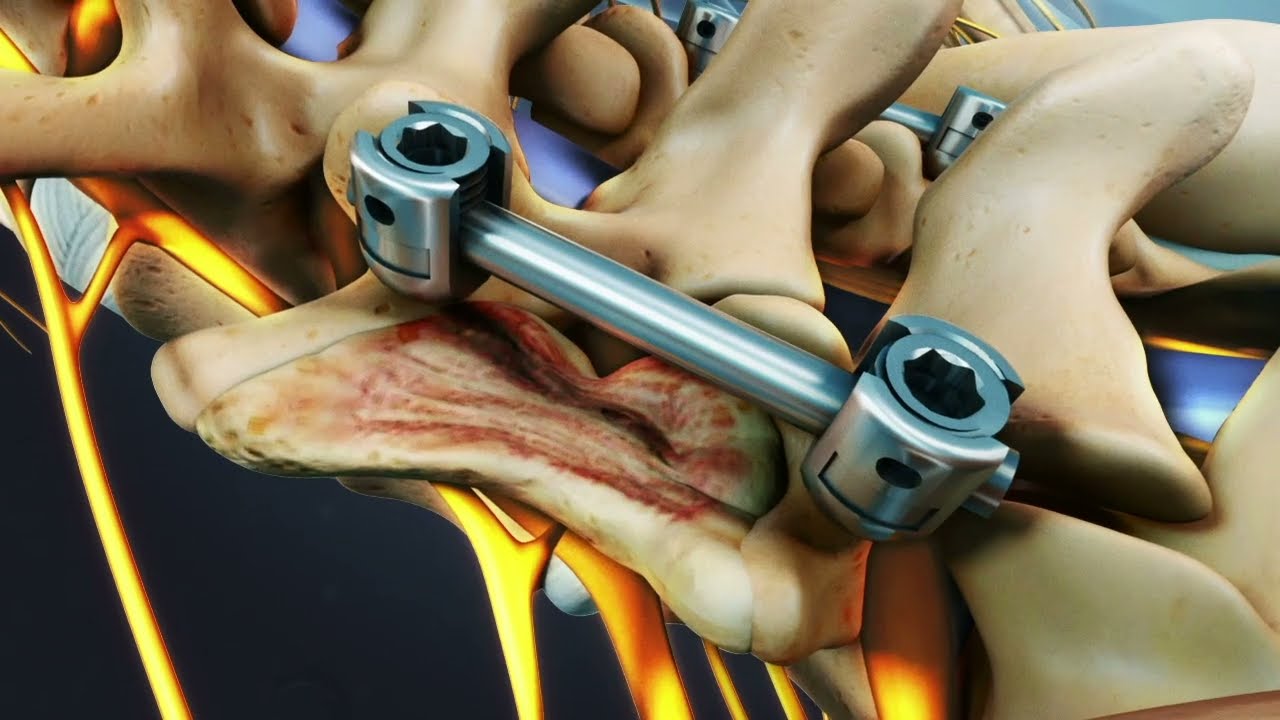
The first animation explains spondylolisthesis and the non-surgical treatments tried first. The second shows a posterolateral fusion: bone graft laid along the sides of the spine, held still by screws and rods while it heals.
Spondylolisthesis 2¼ min
Posterolateral fusion 2 min
Your recovery, step by step
Fusion recovery is a gradual process. Select a milestone to see what happens and what to do. Individual recovery varies, and your surgeon will personalize the plan.
Before surgery
A few medication changes help make surgery safer.
- Stop over-the-counter medications, vitamins, and herbal supplements at least a full week before surgery. Some can interact with anesthesia.
- Aspirin, anti-inflammatories (Advil, Aleve and similar), fish oil, and prescription blood thinners are stopped 1 week before surgery, but only once your primary care physician or specialist clears it. Tell your surgeon if you can't stop them; surgery may otherwise be delayed.
- Pre-operative clearance from your primary care physician or other specialist is arranged as part of scheduling.
- Avoid all nicotine. It interferes with wound healing and bone fusion.
Surgery day
Fusion is an inpatient surgery, so plan to stay in the hospital for a few days.
- Nothing to eat or drink after midnight unless you're told otherwise. The hospital may update your instructions the day before.
- Arrive at least 2 hours early. You'll meet your nurse and anesthesiologist, and your surgeon or physician assistant will answer any last questions.
- You're fully asleep under general anesthesia. Surgery typically takes 2 to 4 hours, depending on the number of levels.
- A bladder catheter is placed during surgery, and a small drain may be placed in the wound.
- After 1 to 2 hours in the recovery room, you move to your hospital room, where your family can join you.
In the hospital
Most patients go home 2 to 3 days after surgery.
- A pain pump (PCA) lets you control your pain medication at first.
- You'll be up and walking early with help from a physical therapist or nurse, possibly with a walker for the first day or two.
- The drain and bladder catheter are typically removed within 24 to 48 hours, and your diet advances from liquids to solids.
- A physical therapist teaches you safe ways to move, dress, and get around without straining your back.
- A sore throat from the breathing tube is common and passes quickly.
- Arrange a ride home in advance; you can't drive yourself.
The first weeks at home
Activity, not bed rest. A daily walking program starts now and continues for the first 12 weeks.
- Avoid frequent bending, lifting, and twisting. Squat to reach down, hold objects close to your body, and lift nothing heavier than a gallon of milk until your surgeon says otherwise.
- No weightlifting, stretches, sit-ups, or leg lifts.
- Don't drive while taking narcotic pain medication. Ideally avoid driving for the first 2 to 3 weeks.
- Take stairs slowly, one step at a time, with a handrail. Avoid sitting upright for long periods; stand, walk, or change positions often.
- Keep a regular schedule and avoid naps so you sleep well at night.
- Leave the first dressing on for 48 hours, then change it daily until drainage stops. Some drainage for the first 4 to 5 days is normal.
- Shower once drainage has stopped. No baths, swimming, or hot tubs for 6 weeks.
- No anti-inflammatories until our office clears them, and no nicotine. Both can interfere with the fusion.
3 weeks: first post-op visit
Your first office visit is typically about 3 weeks after you leave the hospital.
- The team checks how your incision is healing and reviews your progress.
- Incision soreness is usually mild and mostly healed by 3 to 6 weeks. Deeper muscle soreness takes longer after a fusion, often 6 to 12 weeks.
- Keep walking. Continue avoiding bending, lifting, and twisting.
6 to 8 weeks: light work
Strenuous work is avoided for the first 6 to 8 weeks. After that:
- Light work activities are allowed.
- Bending, lifting, and twisting are allowed and gradually increased as the fusion heals.
- The goal is to be off narcotic pain medication and muscle relaxers by 6 to 12 weeks at the most.
12 weeks: rebuilding strength
The prescribed home walking program runs through about 12 weeks. Physical therapy is usually saved for these later stages, once the fusion can handle more stress, and may be used for final reconditioning and strengthening. Activity keeps building gradually.
About 6 months: solid fusion
Lumbar fusions take a minimum of about 6 months to fully heal. For a workers' compensation claim, this is typically when maximum medical improvement (MMI) is reached and you're released to normal duties. Permanent restrictions may or may not be needed, depending on your job; any impairment rating the claim requires is provided then. Nerve recovery can continue for up to 18 months, with most improvement in the first 3 to 6 months.
Return to work, at a glance
The typical course after lumbar fusion, for patients, employers, adjusters, and case managers. Restrictions are documented at each visit and adjusted to the job.
| When | Work status |
|---|---|
| Hospital stay | Typically 2 to 3 days. |
| First 6 to 8 weeks | No strenuous work. No frequent bending, lifting, or twisting, and nothing heavier than a gallon of milk until cleared. |
| After 6 to 8 weeks | Light work activities allowed. Bending, lifting, and twisting are gradually increased as the fusion heals. |
| About 6 months | Solid fusion; typically released to normal duties. Permanent restrictions may or may not be prescribed, depending on the job. |
Restrictions protect a healing fusion, but they don't prevent re-injury.
What's normal while you heal
- Burning, itching, numbness, or swelling along the incision
- Twinges of pain, numbness, or tingling down the legs, sometimes with a dull ache
- Some wound drainage for the first 4 to 5 days
- Muscle soreness around the surgery site for 6 to 12 weeks
Call the office if you notice
- Drainage after 7 days
- Increasing redness
- Visible pus
- Fever above 101.5°F
- Bladder or bowel changes
- New neurological symptoms
Call (913) 322-2700, 8:00 AM to 4:30 PM. For medication refills, press extension 2 and allow 48 hours.
When can I go back to work after a lumbar fusion?
Strenuous work is avoided for the first 6 to 8 weeks. After that, light work activities are allowed, and bending, lifting, and twisting are gradually increased as the fusion heals. The fusion takes about 6 months to become solid, which is typically when patients are released to normal duties. Permanent restrictions may or may not be needed, depending on the job.
What are the risks?
As with any surgery, spinal fusion carries risks. Your surgeon will review them with you in detail and answer your questions before your surgery date.
Will I still have symptoms after surgery?
Some, for a while, and it varies from person to person. Surgery takes the pressure off the nerves; your body's healing determines the final result. Fusion involves more muscle and soft-tissue healing than smaller spine surgeries, so expect soreness to take longer to settle. Intermittent back or leg pain, numbness, or tingling while you heal is normal.
How is pain medication handled?
You'll typically go home with a pain medication and a muscle relaxer. The plan is to taper them, starting with the first or second refill, and have you off both by 6 to 12 weeks at the most. Anti-inflammatories stay on hold until our office clears them. Insurance and pharmacy rules can affect what's dispensed. Refill requests go to (913) 322-2700, extension 2, with a 48-hour processing window.
This guide supplements, and does not replace, the spine team's in-person explanation. If you have questions not answered here, call our office at (913) 322-2700.