

1. Premier Spine Care
  2. Spinal Stenosis
Condition · Neck and low back

Spinal Stenosis Treatment in Kansas City

Spinal stenosis is a narrowing of the canal that holds the spinal cord and nerves. It develops slowly with age and arthritis. Treatment depends on how much it limits you, not on how the MRI looks.

Medically reviewed by Adrian P. Jackson, MD, board-certified, fellowship-trained spine surgeon · Updated November 2026

Appointments are scheduled through workers’ compensation referrals in Kansas and Missouri.

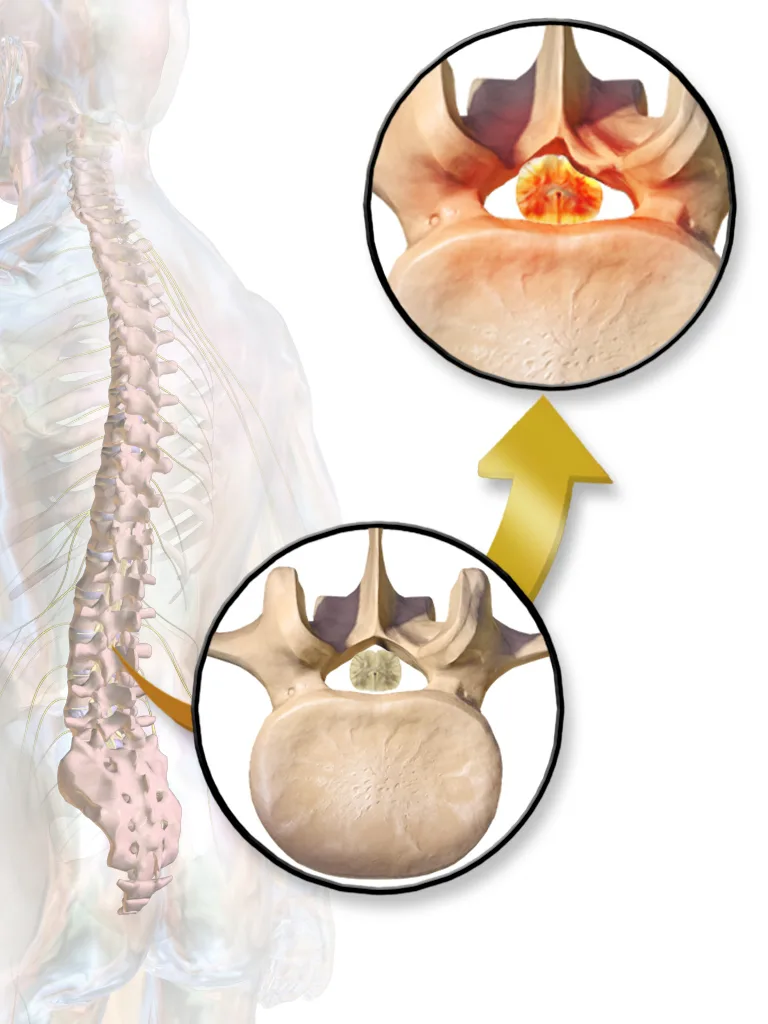
Cross-sections of the spine showing a normal spinal canal and a canal narrowed by stenosis, with the nerves compressed
Bottom: a normal canal. Top: the canal narrowed by thickened joints and ligaments, crowding the nerves. Illustration: BruceBlaus, CC BY 3.0.

The short answer

Spinal stenosis means the spinal canal has narrowed, most often from arthritis, thickened ligaments and bulging discs. In the low back it causes leg pain, heaviness or numbness with standing and walking. In the neck it can press on the spinal cord and affect the hands and balance.

Mild stenosis is managed with physical therapy, medication and injections. When symptoms limit walking or daily life, surgery to open the canal (a laminectomy) reliably relieves the pressure.

What is happening

Less room for the nerves

Over the years the discs lose height, the small joints of the spine enlarge and the ligaments thicken. Each change takes a little room from the canal. Eventually the nerves are crowded.

In the low back, standing and walking narrow the canal further, so the legs ache, tire or go numb. Sitting or leaning forward, for example over a shopping cart, opens the canal and brings relief. That pattern is the hallmark of lumbar stenosis.

In the neck, stenosis can compress the spinal cord. That condition is called cervical myelopathy and is treated differently, because the spinal cord does not tolerate pressure the way nerve roots do.

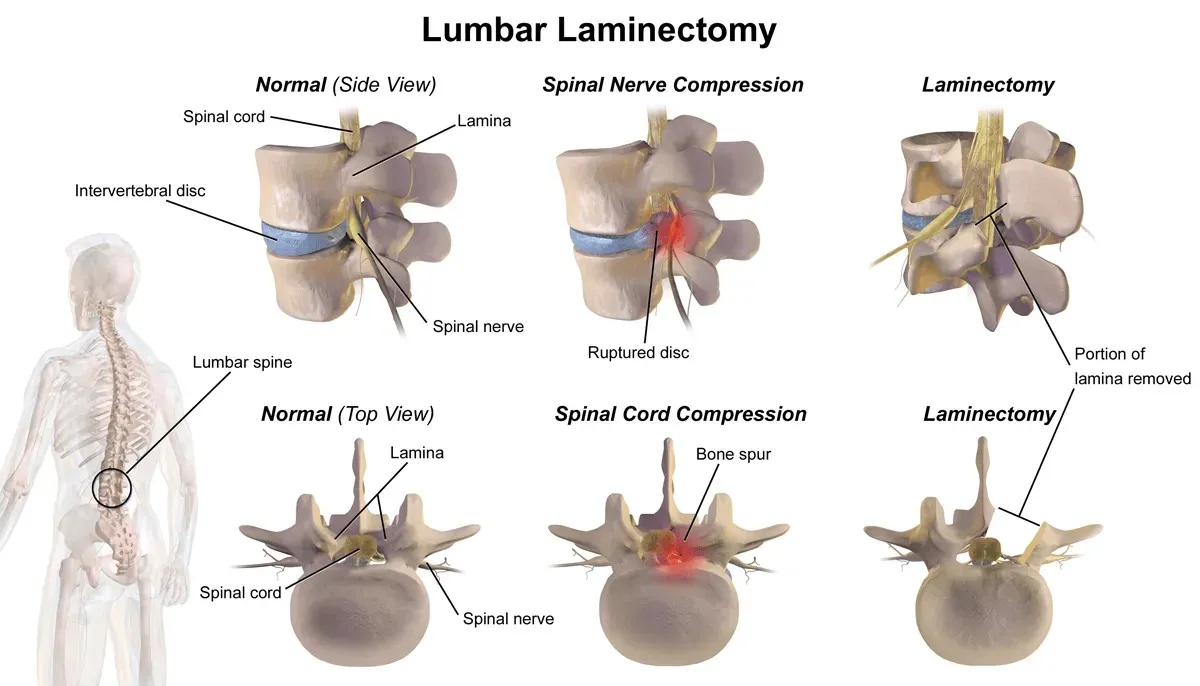
Side and top views of the lumbar spine: normal anatomy, nerve compression from a disc or bone spur, and the canal after decompression
Left: normal. Middle: a disc or bone spur compressing the nerves. Right: the canal after decompression. Illustration: BruceBlaus, CC BY-SA 4.0.
Symptoms

Signs of spinal stenosis

  • Leg pain or heaviness with walking

    Aching, cramping or tiredness in the buttocks and legs that builds the farther you walk.

  • Relief when you sit or bend forward

    Symptoms ease within minutes of sitting. Leaning on a cart or walker lets you go farther.

  • Numbness or tingling

    In the legs or feet, often in both legs.

  • Hand clumsiness or unsteady walking

    These point to stenosis in the neck and should be evaluated promptly.

Is it my circulation or my spine?

Poor circulation in the legs can also cause leg pain with walking. The difference: circulation pain eases when you simply stop and stand still. Stenosis pain usually needs you to sit or bend forward. An examination and imaging tell the two apart.

If this began with an injury at work, our office handles workers' compensation claims in Kansas and Missouri every day. See how a work-injury claim moves from referral to full duty.

Get care right away if you have

  • New trouble controlling your bladder or bowels
  • Numbness in the groin or inner thighs
  • Weakness in a leg or arm that is getting worse
  • Severe pain after a fall, crash or other injury
  • Fever with new back or neck pain

These can signal pressure on the nerves or spinal cord that should not wait. Call 911 or go to the nearest emergency room.

Treatment

Treatment for spinal stenosis

Stenosis does not always get worse. Many people manage it for years without surgery.

  1. First

    Physical therapy and activity

    Flexion-based exercises, core strengthening and staying active. A stationary bike is often comfortable because it keeps the spine bent forward.

  2. First

    Medication

    Anti-inflammatory and nerve-pain medication when appropriate for your health.

  3. Some patients

    Epidural steroid injections

    Injections can reduce leg symptoms for weeks to months and help you stay active.

  4. If needed

    Decompression surgery

    A lumbar laminectomy removes the bone and ligament crowding the nerves. If the spine is also unstable, a fusion may be added at the same time.

Short video

See how a laminectomy opens the canal

This animation shows where the nerves are crowded and how removing a small amount of bone and ligament gives them room again.

Most of our patients go home the same day after a lumbar decompression. The recovery guide covers each week.

Your surgeons

Two fellowship-trained spine surgeons

Adrian P. Jackson, MD

Adrian P. Jackson, MD

Board-certified, fellowship-trained spine surgeon

Dr. Jackson has practiced spine surgery in the Kansas City area for more than 20 years. He treats both the neck and the low back, and he operates exclusively on an outpatient basis using minimally invasive techniques.

  • Board certified, American Board of Orthopaedic Surgery
  • Spine fellowship, Twin Cities Spine Center
  • Orthopaedic residency, Northwestern University

About Dr. Jackson
John M. Ciccarelli, MD

John M. Ciccarelli, MD

Board-certified, fellowship-trained spine surgeon

Dr. Ciccarelli specializes in the lumbar spine, including fusion for spondylolisthesis and other conditions where the spine needs to be stabilized.

  • Board certified, American Board of Orthopaedic Surgery
  • Spine fellowship, Scoliosis and Spine Center, Baltimore
  • Orthopaedic residency, Orlando Regional Medical Center
About Dr. Ciccarelli
Common questions

Questions patients ask

Does spinal stenosis always need surgery?

No. Many people control their symptoms with exercise, medication and occasional injections. Surgery is considered when leg symptoms limit walking and daily activities despite that care, or when there is weakness or loss of bladder or bowel control.

Will stenosis get worse over time?

It changes slowly. Some people stay the same for years, some gradually worsen and some improve. Sudden worsening is uncommon and should be checked.

How successful is surgery for lumbar stenosis?

Decompression surgery is one of the more reliable operations in spine care for relieving leg pain and improving walking distance. It is less predictable for back pain alone, which is why the decision is based mainly on leg symptoms.

How long is the recovery after a laminectomy?

Most patients walk the day of surgery and go home the same day. Our routine protocol allows full-time work with restrictions at about 6 weeks and full activity at about 12 weeks.

What is the difference between stenosis and a herniated disc?

A herniated disc is a single event where disc material presses on a nerve, often in younger adults. Stenosis is a gradual narrowing from arthritis, usually after age 50. Both can cause leg pain, and they can occur together.

This page is general education. It does not replace an examination, and it is not medical advice for your situation. If you have severe or sudden symptoms, call 911 or go to the nearest emergency room.

Appointments for work injuries

Premier Spine Care schedules appointments through workers’ compensation referrals in Kansas and Missouri. Case managers, adjusters and law offices can send a referral online, and the appointment is scheduled within 24 hours. If you were hurt at work, ask your adjuster or case manager about a referral.

Premier Spine Care · Overland Park and Lenexa, Kansas · Serving the Kansas City metro in Kansas and Missouri
Call Refer a patient