

1. Premier Spine Care
  2. Degenerative Disc Disease
Condition · Neck and low back

Degenerative Disc Disease Treatment in Kansas City

Degenerative disc disease is not really a disease. It is the name for discs that have worn with age. Nearly everyone has some of it on an MRI, and most people with it never need surgery.

Medically reviewed by Adrian P. Jackson, MD, board-certified, fellowship-trained spine surgeon · Updated November 2026

Appointments are scheduled through workers’ compensation referrals in Kansas and Missouri.

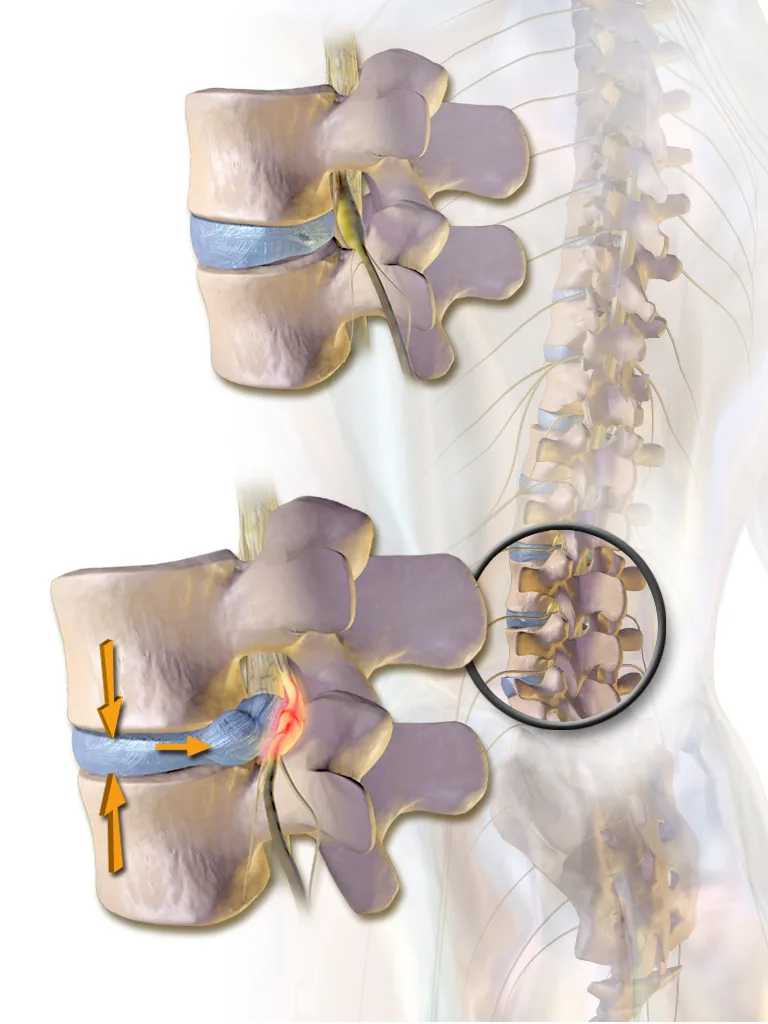
A healthy spinal disc above and a damaged disc below bulging toward the spinal nerve
Top: a healthy disc. Bottom: a damaged disc that has lost height and bulges toward the nerve. Illustration: BruceBlaus, CC BY 3.0.

The short answer

Degenerative disc disease describes discs that have dried out, lost height and stiffened with age. It can cause neck or back pain that flares and settles, and it can lead to other problems such as a herniated disc, stenosis or a slipped vertebra.

Most people manage it with exercise, physical therapy, weight control and medication during flare-ups. Surgery is not done for disc wear alone. It is considered when the worn disc is pinching a nerve, compressing the spinal cord or making the spine unstable.

What is happening

Discs change with age

A young disc is mostly water. It is tall, flexible and a good shock absorber. Over the decades discs lose water, flatten and develop small tears in the outer ring. Genetics, smoking, heavy physical work and earlier injuries speed the process.

These changes are a normal part of aging, like gray hair. Studies of people with no back pain show disc degeneration on MRI in a large share of adults, and the share rises with each decade.

That is why the MRI report alone does not decide anything. What matters is whether a particular disc explains your particular symptoms.

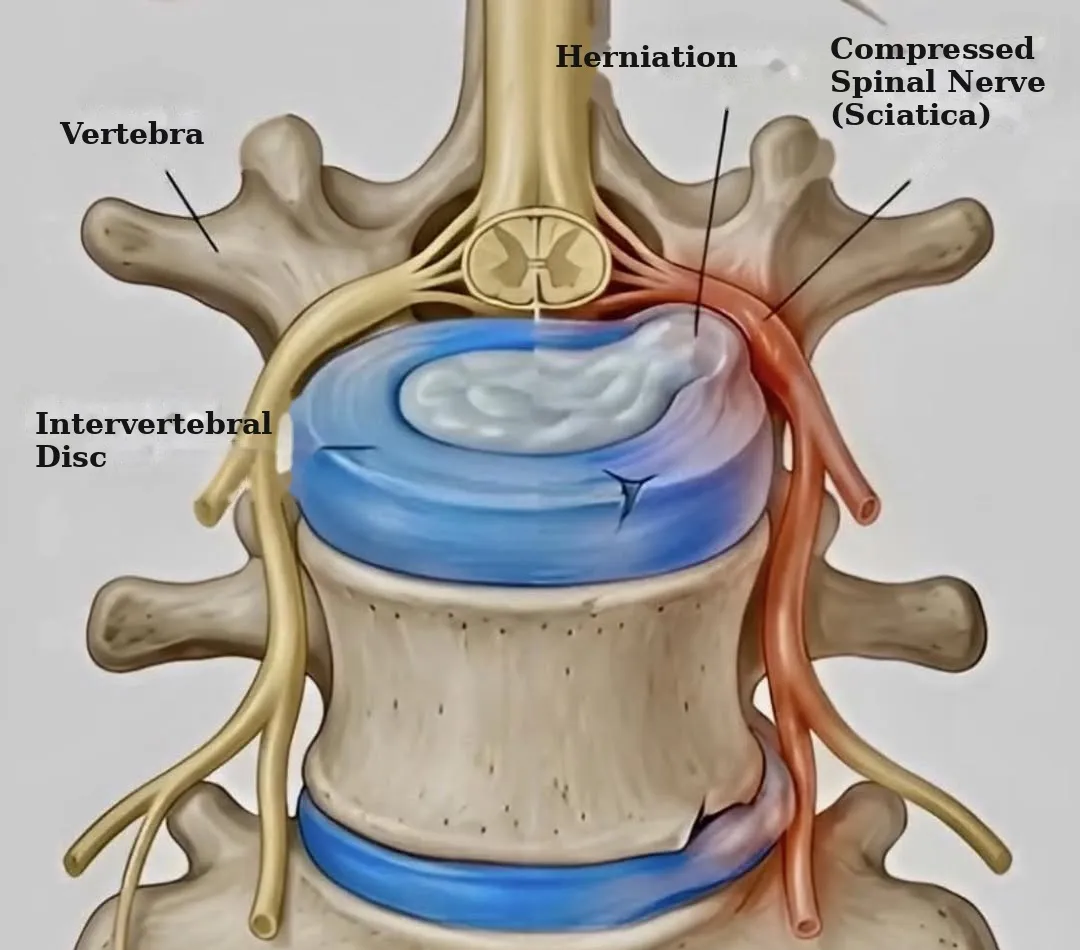
A lumbar disc pressing on an exiting spinal nerve, shown in red
A worn disc becomes a surgical problem mainly when it presses on a nerve, as shown here in red.
Symptoms

How worn discs can feel

  • Pain that comes and goes

    Flare-ups lasting days to weeks, with better stretches in between.

  • Worse with sitting, bending or lifting

    Low back discs carry more load when you sit or bend forward.

  • Stiffness

    Especially first thing in the morning or after staying in one position.

  • Arm or leg symptoms

    Shooting pain, numbness or weakness mean a nerve is involved and deserve an evaluation.

What it can lead to

A worn disc can herniate (herniated disc), contribute to narrowing of the canal (spinal stenosis), or allow one vertebra to slip over another (spondylolisthesis). Those are the conditions that surgery treats well.

If this began with an injury at work, our office handles workers' compensation claims in Kansas and Missouri every day. See how a work-injury claim moves from referral to full duty.

Get care right away if you have

  • New trouble controlling your bladder or bowels
  • Numbness in the groin or inner thighs
  • Weakness in a leg or arm that is getting worse
  • Severe pain after a fall, crash or other injury
  • Fever with new back or neck pain

These can signal pressure on the nerves or spinal cord that should not wait. Call 911 or go to the nearest emergency room.

Treatment

What actually helps

The aim is to stay strong and active, and to treat flare-ups without letting them stop you.

  1. Everyone

    Exercise and physical therapy

    Core and hip strengthening, flexibility and regular aerobic exercise such as walking or swimming. This is the most effective long-term treatment.

  2. Everyone

    Healthy habits

    Keeping weight down, not smoking, and lifting with good mechanics all reduce the load on the discs.

  3. During flare-ups

    Medication and injections

    Anti-inflammatory medication for short periods. An epidural steroid injection may help when a nerve is irritated.

  4. Selected patients

    Surgery for a specific problem

    Surgery is considered when a worn disc causes nerve or spinal cord compression or instability. In the neck that may be an ACDF or a disc replacement. In the low back it may be a decompression or a fusion.

Your surgeons

Two fellowship-trained spine surgeons

A large part of a spine surgeon's job is telling people when surgery will not help. When an operation is the right choice, it is matched to the specific problem.

Adrian P. Jackson, MD

Adrian P. Jackson, MD

Board-certified, fellowship-trained spine surgeon

Dr. Jackson has practiced spine surgery in the Kansas City area for more than 20 years. He treats both the neck and the low back, and he operates exclusively on an outpatient basis using minimally invasive techniques.

  • Board certified, American Board of Orthopaedic Surgery
  • Spine fellowship, Twin Cities Spine Center
  • Orthopaedic residency, Northwestern University

About Dr. Jackson
John M. Ciccarelli, MD

John M. Ciccarelli, MD

Board-certified, fellowship-trained spine surgeon

Dr. Ciccarelli specializes in the lumbar spine, including fusion for spondylolisthesis and other conditions where the spine needs to be stabilized.

  • Board certified, American Board of Orthopaedic Surgery
  • Spine fellowship, Scoliosis and Spine Center, Baltimore
  • Orthopaedic residency, Orlando Regional Medical Center
About Dr. Ciccarelli
Common questions

Questions patients ask

Is degenerative disc disease serious?

Usually not. It is common, it is part of aging, and most people have manageable symptoms or none. It becomes more significant when it leads to nerve compression, spinal cord compression or instability.

Will it keep getting worse?

Disc wear progresses slowly with age, but pain does not necessarily follow. Many people find that painful flare-ups become less frequent over the years as the worn segment stiffens.

Can a worn disc be repaired or regrown?

There is no proven treatment that restores a worn disc. Treatment focuses on strength, function and relieving any pressure on nerves.

When is fusion considered for disc degeneration?

Fusion is considered for a specific, clearly identified problem, such as a slipped vertebra, instability, or nerve compression that cannot be relieved without stabilizing the spine. It is not a routine treatment for back pain from disc wear alone.

Should I get a second opinion before spine surgery?

It is reasonable for any elective spine operation, especially a fusion. Learn about second opinions.

This page is general education. It does not replace an examination, and it is not medical advice for your situation. If you have severe or sudden symptoms, call 911 or go to the nearest emergency room.

Appointments for work injuries

Premier Spine Care schedules appointments through workers’ compensation referrals in Kansas and Missouri. Case managers, adjusters and law offices can send a referral online, and the appointment is scheduled within 24 hours. If you were hurt at work, ask your adjuster or case manager about a referral.

Premier Spine Care · Overland Park and Lenexa, Kansas · Serving the Kansas City metro in Kansas and Missouri
Call Refer a patient