
Lumbar Decompression and Discectomy
A lumbar laminotomy or laminectomy, with or without a discectomy, relieves pressure on pinched nerves in the low back. Most of our Kansas City-area patients go home the same day, and the typical path back to full duty is about 12 weeks.
Medically reviewed by Adrian P. Jackson, MD and John M. Ciccarelli, MD, board-certified, fellowship-trained spine surgeons · Updated October 2026
When a disc or arthritis pinches a nerve
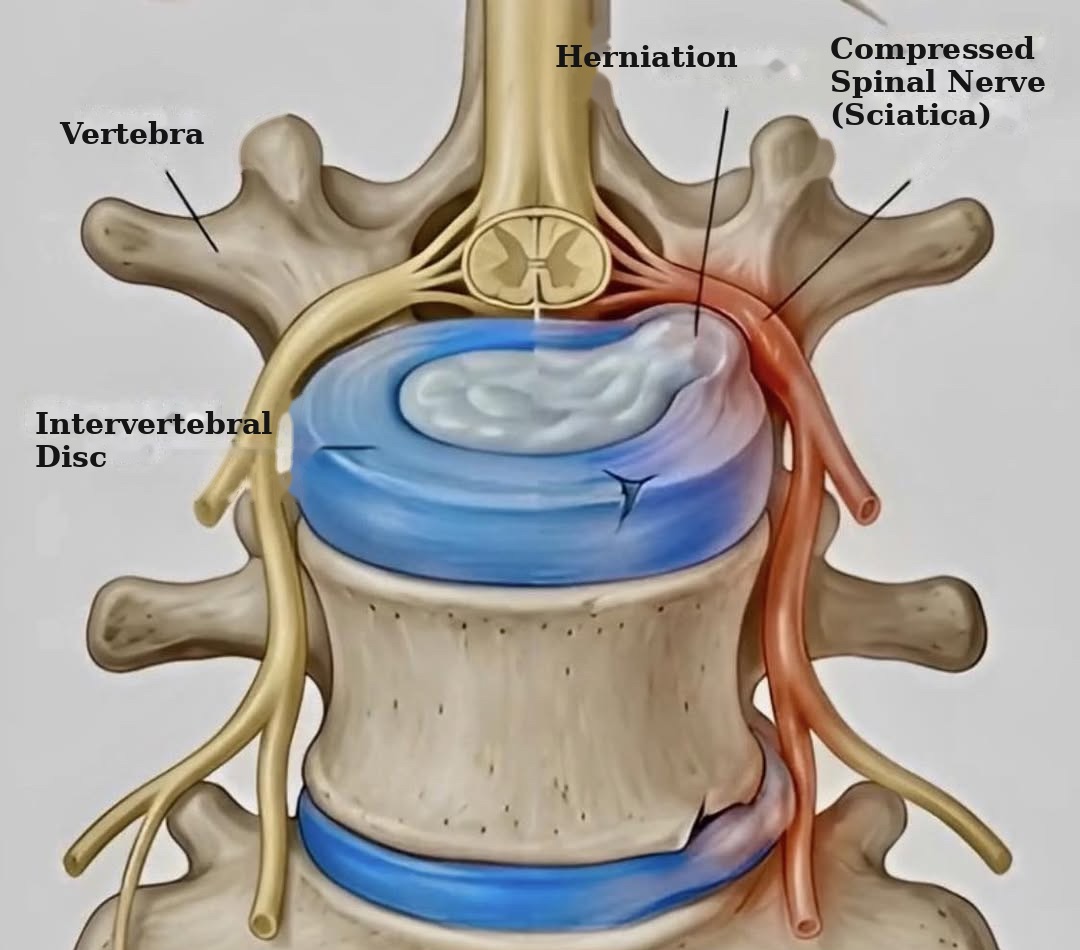
Discs are the shock-absorbing cushions between the vertebrae. Age, repetitive stress, strain, or trauma can cause a disc to herniate, pushing its soft inner material against the nerves that run alongside the spinal column. The result is usually low back pain with pain, numbness, or tingling down the leg, often called sciatica.
Arthritis can pinch a nerve root the same way, even without a herniated disc. Spinal stenosis, an arthritic narrowing of the canal, often causes leg cramping with walking. These conditions are treated in a similar way: the goal of any decompression is to take pressure off the nerve.
Lumbar decompression is recommended only after all conservative care, such as medications, physical therapy, and epidural steroid injections, has failed to provide enough relief. MRI, CT, and occasionally a myelogram pinpoint the exact level to treat.
Make room for the nerve
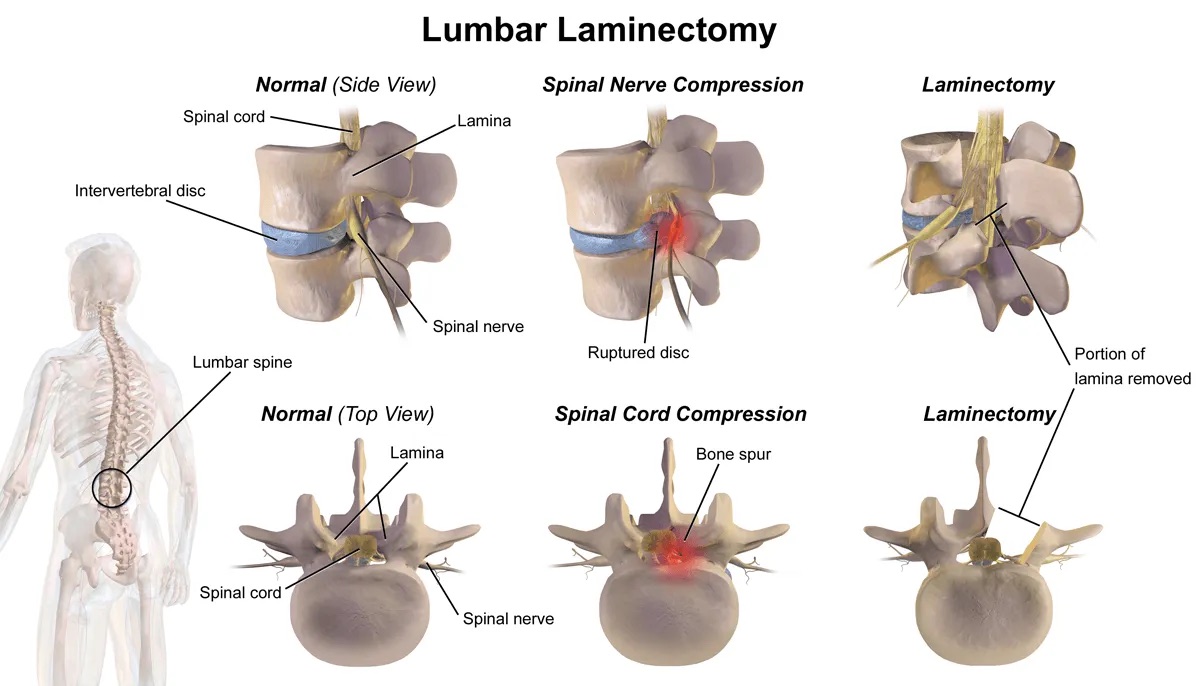
Laminotomy or laminectomy. Through an incision on the low back, the surgeon creates a small window in the lamina, the bony roof of the spinal canal, or removes a portion of it, to reach the compressed nerve.
Discectomy. If a herniated disc is pressing on the nerve, that disc material is removed, relieving the pressure so the nerve can recover as much function as possible.
When appropriate, a minimal-access tube system is used to limit muscle disruption. With a tube, the incision sits slightly off the midline; with a traditional approach, it's in the midline. Either way, care is taken to limit tissue trauma so you recover quickly.
- 1–2 hoursTypical time in surgery
- Same dayMost patients go home from the recovery room
- Walking in hoursEarly walking helps prevent blood clots and pneumonia
- No braceYou won't be immobilized after surgery
See how it works
These animations show how a herniated disc or narrowed canal pinches the nerve, and how each procedure relieves the pressure. Your surgery may include one or both.
Discectomy 1½ min

Laminectomy 1¾ min

Your recovery, step by step
Select a milestone to see what happens and what to do. Individual recovery varies, and your surgeon will personalize the plan.
Before surgery
Once surgery is scheduled, a few steps keep it on track.
- Pre-register with the surgery center shortly after scheduling.
- Lab work (a blood draw and urine sample) 12 to 14 days before surgery. Fast for 4 to 6 hours beforehand but keep drinking water.
- Medications: the pre-operative nurse will tell you when to stop each one.
- Call us if your symptoms change, your pain resolves, or you develop any infection, even an unrelated one such as a dental abscess. We'll discuss whether it affects your surgery date.
- Need to reschedule? Let us know at least 10 days ahead whenever possible.
Surgery day
Most patients walk within hours and go home the same day.
- Nothing to eat or drink after midnight unless you're told otherwise.
- Arrive at least 2 hours early. You'll meet your nurse and anesthesiologist, and your surgeon will answer any last questions.
- You're fully asleep under general anesthesia. The procedure typically takes 1 to 2 hours.
- After 1 to 2 hours in the recovery room, once you're awake and stable, you go home. Arrange a ride; you can't drive yourself.
- Low-back soreness from the surgery is common and eases with walking and mild pain medication.
The first weeks at home
For the first 3 weeks, walking is your main therapy. There's no such thing as too much walking.
- Don't drive while taking narcotic pain medication or muscle relaxers. Ideally avoid driving the first week.
- Stairs are fine; use a handrail. Change positions often, since staying in one position too long causes soreness.
- Leave the dressing on for 48 hours. Showers are fine; keep the incision clean and dry. No baths, swimming, or hot tubs for 6 weeks.
- Ice on the low back often helps. Keep the incision dry while icing.
- No anti-inflammatories (Advil, Motrin, Aleve, Celebrex and similar) until cleared; they can cause bleeding after surgery.
- No nicotine of any kind. It interferes with wound healing and nerve recovery.
- A "honeymoon" period of relief followed by fluctuating symptoms after about two weeks is a normal part of nerve healing.
3 weeks: first post-op visit
Most patients start to feel like themselves again around now.
- Your first follow-up visit with the surgical team.
- The goal is to be off narcotic pain medication and muscle relaxers by 3 weeks. Anti-inflammatories are typically resumed around this time.
- Physical therapy becomes an option, though not every patient needs it for an optimal recovery.
- A restricted return to work is possible between 3 and 6 weeks, especially for sedentary jobs or with a part-time accommodation.
- Incision soreness is largely resolved by 3 to 6 weeks.
6 weeks: full-time work with restrictions
Our routine protocol returns you to full-time work (40 hours per week) with these restrictions for the next 6 weeks:
- No lifting more than 15 pounds
- No repetitive bending or lifting
- Alternate sitting and standing as needed
12 weeks: released to full duty
At about 3 months, most patients are released to their ordinary duties without restrictions. For a workers' compensation claim, this is typically when maximum medical improvement (MMI) is reached and any impairment rating the claim requires is provided.
Up to 18 months: nerves keep healing
Surgery removes the pressure; your body does the rest. Leg pain usually improves first, while numbness, tingling, and strength recover more gradually. Most improvement happens in the first 3 to 6 months, and nerve recovery can continue for up to 18 months.
Return to work, at a glance
Our routine protocol after lumbar decompression, for patients, employers, adjusters, and case managers. Restrictions are documented at each visit.
| When | Work status |
|---|---|
| Surgery to 6 weeks | Off work for up to 6 weeks. A restricted return is possible between 3 and 6 weeks if the job is sedentary or the employer can accommodate part-time work. |
| 6 to 12 weeks | Full-time (40 hours per week) with restrictions: no lifting over 15 pounds, no repetitive bending or lifting, and alternate sitting and standing as needed. |
| 12 weeks | Typically released to ordinary duties without restrictions. |
What's normal while you heal
- Burning, itching, numbness, or swelling around the incision
- Twinges of pain, numbness, or tingling down the legs, sometimes with a dull backache
- Low-back soreness from the surgery
- Good days and bad days after the first two weeks
Call the office if you notice
- Drainage after 7 days
- Increasing redness
- Visible pus
- Fever above 101.5°F
- Bladder or bowel changes
- New neurological symptoms
Call (913) 322-2700, 8:00 AM to 4:30 PM. For medication refills, press extension 2 and allow 48 hours.
When can I go back to work after a lumbar decompression or discectomy?
Our routine protocol: off work for up to 6 weeks, with a restricted return possible between 3 and 6 weeks if your job is sedentary or your employer can accommodate part-time work. At 6 weeks, full-time work (40 hours per week) with restrictions: no lifting over 15 pounds, no repetitive bending or lifting, and alternating sitting and standing as needed. At about 12 weeks, most patients are released to ordinary duties without restrictions.
What are the possible risks?
As with any surgery, lumbar decompression carries risks, including but not limited to: infection; excessive bleeding; a dural tear with spinal fluid leak; spinal cord or nerve root injury that could result in paralysis; partial or no relief of symptoms; worsening of symptoms; and anesthetic or medical complications such as heart attack, stroke, pulmonary embolism, or death. Your surgeon will review these with you and answer your questions before your surgery date.
Will I still have symptoms after surgery?
Possibly, and it varies from person to person. Surgery relieves the pressure on the nerve; your body's biological healing determines the long-term result. Recovery is sometimes immediate and complete, sometimes gradual, and occasionally never fully complete.
How is pain medication handled?
You'll typically receive a pain medication and a muscle relaxer. The goal is to be off both within 3 weeks. Anti-inflammatories are held until our office clears them, usually around 3 weeks. Insurance and pharmacy rules can affect what's dispensed. Refill requests go to (913) 322-2700, extension 2, with a 48-hour processing window.
This guide supplements, and does not replace, the spine team's in-person explanation. If you have questions not answered here, call our office at (913) 322-2700.