1. Premier Spine Care
  2. Sciatica
Condition · Low back and leg

Sciatica Treatment in Kansas City

Sciatica is pain that travels from the low back or buttock down the leg. It is a symptom, not a diagnosis. Finding what is pressing on the nerve is what leads to the right treatment.

Medically reviewed by Adrian P. Jackson, MD, board-certified, fellowship-trained spine surgeon · Updated November 2026

Appointments are scheduled through workers’ compensation referrals in Kansas and Missouri.

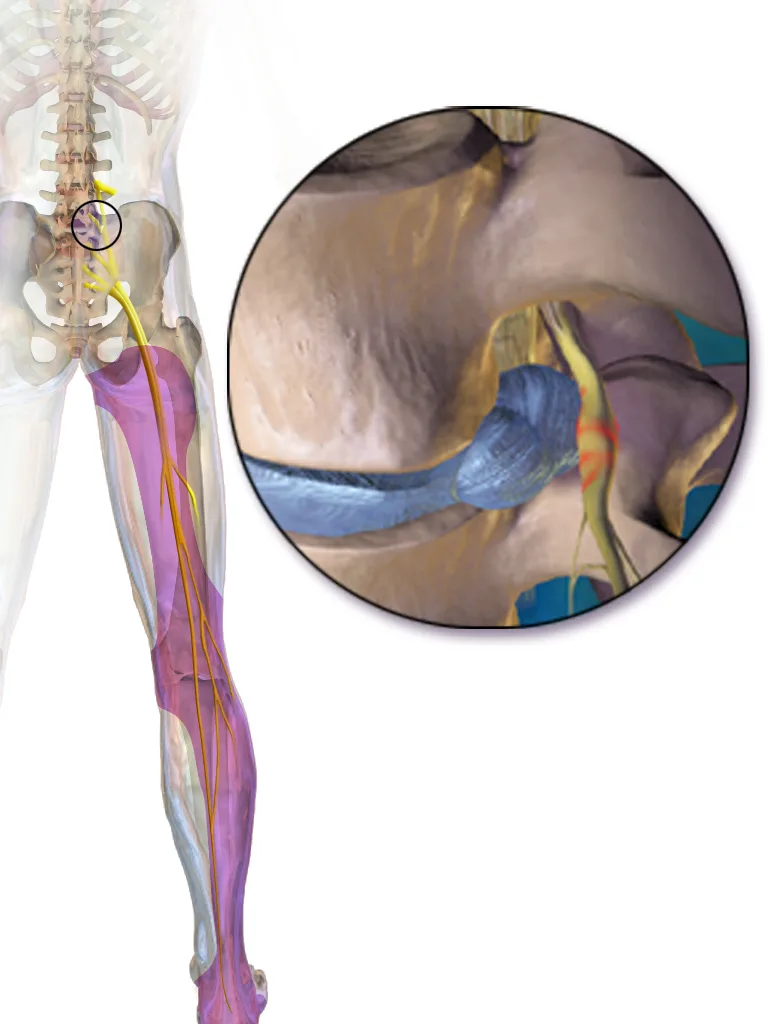
The sciatic nerve running from the low back down the leg, with a close-up of a disc pressing on the nerve root
The sciatic nerve runs from the low back down the leg. Pressure on one of its roots in the spine is felt along that path. Illustration: BruceBlaus, CC BY-SA 4.0.

The short answer

Sciatica is nerve pain in the leg caused by pressure on a nerve root in the lower spine. The most common cause is a herniated disc. Spinal stenosis and a slipped vertebra (spondylolisthesis) are the other frequent causes.

Most sciatica improves with time, physical therapy, medication and sometimes an epidural steroid injection. Surgery is considered for pain that does not improve, for weakness, or for loss of bladder or bowel control, which is an emergency.

Causes

What causes sciatica

The pain is felt in the leg, but the source is almost always in the spine.

  • Herniated disc

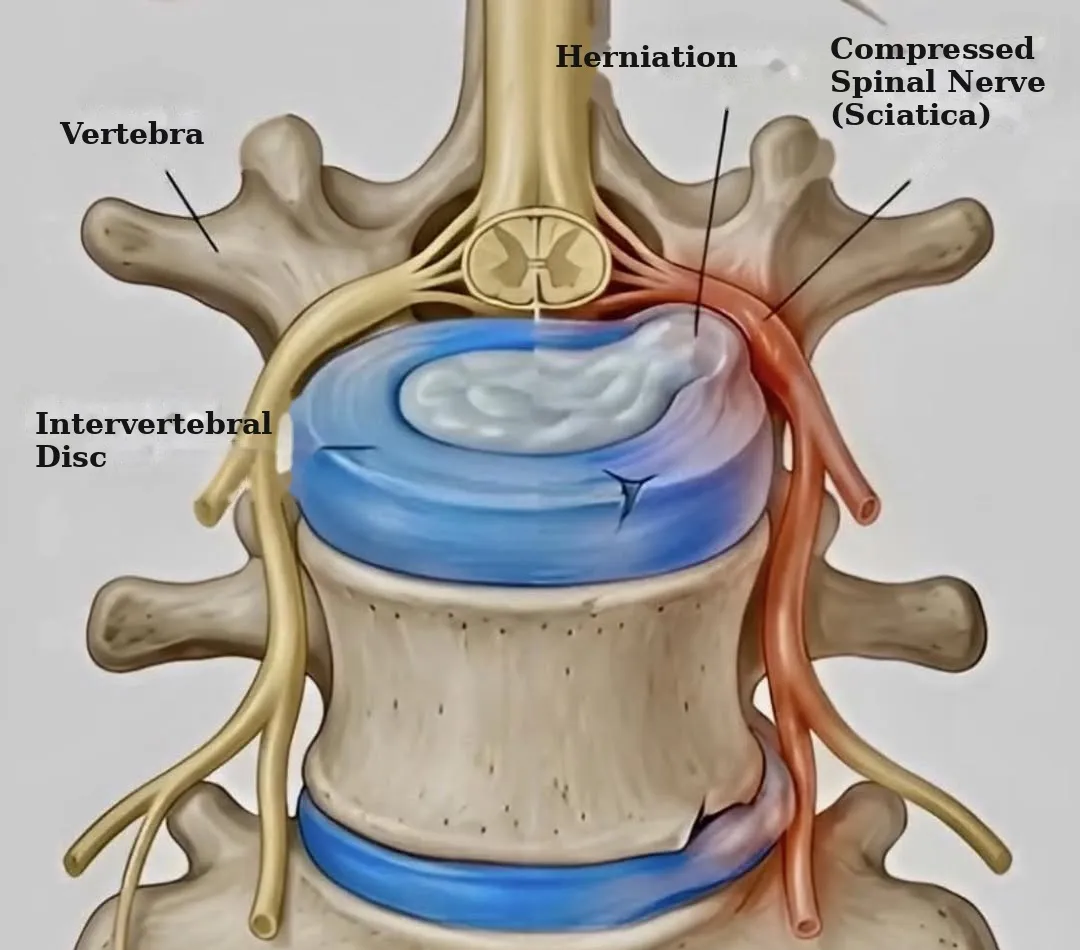
    Disc material presses on a nerve root. This is the most common cause, especially under age 50. About herniated discs.

  • Spinal stenosis

    Arthritis narrows the canal the nerves pass through. Leg pain comes on with standing and walking and eases with sitting. About spinal stenosis.

  • Spondylolisthesis

    One vertebra slips forward over the one below and narrows the space for the nerves. About spondylolisthesis.

  • Other causes

    Less often, a cyst from a spine joint, a fracture or another condition presses on the nerve. Imaging sorts these out.

Symptoms

How sciatica feels

Sciatica usually affects one leg. The pain may be sharp, burning or electric, and it often travels below the knee into the calf or foot. Many people have numbness or tingling in the same area.

  • Leg pain worse than back pain. This pattern points to a nerve being pinched.
  • Worse with sitting, bending or coughing when a disc is the cause.
  • Worse with standing and walking when stenosis is the cause.
  • Weakness such as a foot that drags or trouble rising on the toes.

If this began with an injury at work, our office handles workers' compensation claims in Kansas and Missouri every day. See how a work-injury claim moves from referral to full duty.

A herniated lumbar disc pressing on an exiting spinal nerve, shown in red
The most common cause: a herniated lumbar disc pressing on the nerve (red) as it leaves the spine.
Treatment

How sciatica is treated

Treatment follows the cause. For most people it never involves surgery.

  1. Most patients

    Stay active, with medication as needed

    Walking and normal movement within comfort help more than rest. Short-term anti-inflammatory or nerve-pain medication can take the edge off.

  2. Most patients

    Physical therapy

    Specific exercises reduce pressure on the nerve and build the strength that protects the low back.

  3. Some patients

    Epidural steroid injection

    Medicine placed beside the inflamed nerve can give lasting relief and, just as useful, confirm which nerve is the source.

  4. If needed

    Surgery to free the nerve

    A microdiscectomy removes the disc fragment. A laminectomy opens a canal narrowed by arthritis. Both are usually outpatient procedures.

When sciatica is an emergency

Most sciatica is painful but not dangerous. A few signs change that.

  • Bladder or bowel changes

    New difficulty urinating, loss of control, or loss of the urge to go.

  • Saddle numbness

    Numbness in the groin, genitals or inner thighs.

  • Rapidly worsening weakness

    A leg or foot that is getting weaker over hours or days.

  • Pain in both legs

    Especially with any of the signs above.

Why timing matters

A nerve that has been compressed for a long time recovers more slowly, and sometimes incompletely. That is the reason weakness is taken more seriously than pain alone, and the reason these emergency signs are treated the same day.

Do not wait on these

  • Go to the nearest emergency room
  • Do not eat or drink on the way, in case surgery is needed
  • Bring any imaging you already have

These signs can mean cauda equina syndrome, where the nerves at the base of the spine are compressed. Early surgery protects bladder, bowel and leg function.

Your surgeons

Two fellowship-trained spine surgeons

Adrian P. Jackson, MD

Adrian P. Jackson, MD

Board-certified, fellowship-trained spine surgeon

Dr. Jackson has practiced spine surgery in the Kansas City area for more than 20 years. He treats both the neck and the low back, and he operates exclusively on an outpatient basis using minimally invasive techniques.

  • Board certified, American Board of Orthopaedic Surgery
  • Spine fellowship, Twin Cities Spine Center
  • Orthopaedic residency, Northwestern University
About Dr. Jackson
John M. Ciccarelli, MD

John M. Ciccarelli, MD

Board-certified, fellowship-trained spine surgeon

Dr. Ciccarelli specializes in the lumbar spine, including fusion for spondylolisthesis and other conditions where the spine needs to be stabilized.

  • Board certified, American Board of Orthopaedic Surgery
  • Spine fellowship, Scoliosis and Spine Center, Baltimore
  • Orthopaedic residency, Orlando Regional Medical Center
About Dr. Ciccarelli
Common questions

Questions patients ask

How long does sciatica last?

Most episodes improve within 4 to 6 weeks, and the large majority within about 3 months. Pain that is not improving after 6 weeks, or that comes with weakness, is a reason to see a spine specialist.

Is walking good for sciatica?

Usually, yes. Gentle walking keeps the back moving and does not harm the nerve. If walking brings on leg pain that eases when you sit or lean forward, stenosis may be the cause and is worth having checked.

Do I need an MRI for sciatica?

Not right away in most cases, because most sciatica settles on its own. An MRI is appropriate when pain persists beyond about 6 weeks, when there is weakness, or when an injection or surgery is being considered.

What surgery is done for sciatica?

It depends on the cause. A microdiscectomy removes a herniated disc fragment. A laminectomy opens a canal narrowed by arthritis. Both relieve pressure on the nerve, and most patients go home the same day.

Can sciatica come from a work injury?

Yes. Lifting, twisting and falls at work are common causes of a herniated disc. Our office evaluates work-related spine injuries for patients in Kansas and Missouri, and each visit documents causation and work restrictions.

This page is general education. It does not replace an examination, and it is not medical advice for your situation. If you have severe or sudden symptoms, call 911 or go to the nearest emergency room.

Appointments for work injuries

Premier Spine Care schedules appointments through workers’ compensation referrals in Kansas and Missouri. Case managers, adjusters and law offices can send a referral online, and the appointment is scheduled within 24 hours. If you were hurt at work, ask your adjuster or case manager about a referral.

Premier Spine Care · Overland Park and Lenexa, Kansas · Serving the Kansas City metro in Kansas and Missouri
Call Refer a patient